






LED face masks have become one of the most popular beauty devices for at-home use. Search for “best LED face mask” and you’ll find hundreds of options promising to rejuvenate your skin with red, blue, green, yellow, and orange light—even combinations of seven different colors.
But when it comes to LED light therapy, more colors, more LEDs, or more power don’t necessarily mean better results.
A mask’s effectiveness depends on something much more precise: the right combination of wavelength, irradiance, energy dose, treatment time, and how close the light is to your skin.
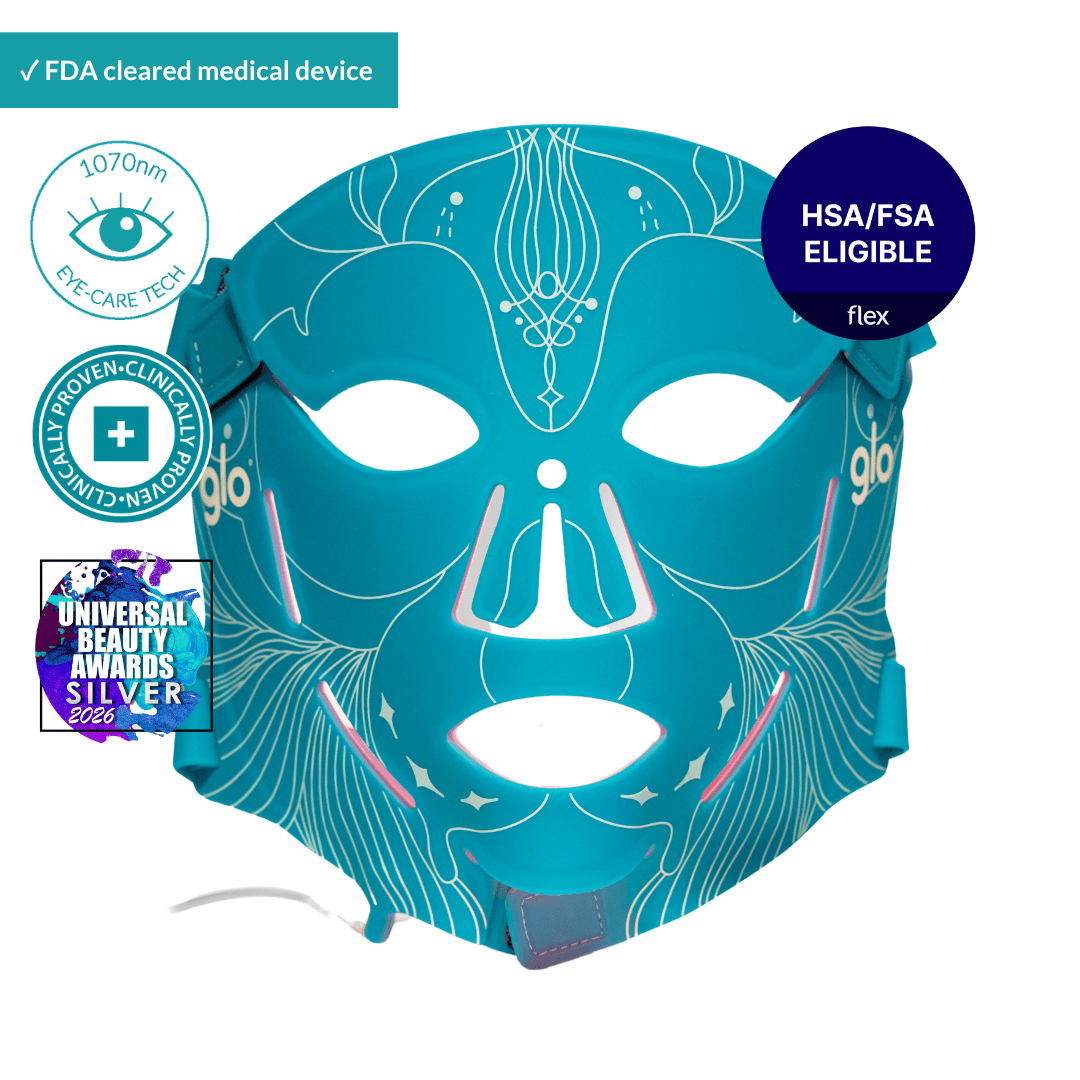
Glo Mask was developed around these principles. It’s an LED light therapy face mask designed specifically to address visible signs of aging and support skin rejuvenation.
What Is an LED Face Mask?
An LED face mask is a device that uses light-emitting diodes (LEDs) to deliver specific wavelengths of light to the skin.
This approach is known as photobiomodulation (PBM).
Unlike technologies that produce intense heat or create controlled injury to the skin, photobiomodulation uses light energy to stimulate certain cellular processes.
Light absorbed by cells may influence processes involved in cellular energy production, tissue repair, and the production of structural components in the skin.
But not all light has the same effect.
Wavelength, measured in nanometers (nm), affects how light interacts with tissue and how deeply it can penetrate.
That’s why one of the first things to check when comparing LED face masks is which wavelengths a device actually uses.
Which Wavelengths Does Glo Mask Use?
Glo Mask combines three wavelengths:
- Red light: 630 nm ±10 nm
- Near-infrared (NIR) light: 830 nm ±10 nm
- Deep near-infrared light: 1070 nm ±20 nm
The goal isn’t to offer a long list of colors simply to add more features. It’s to combine wavelengths selected specifically for facial rejuvenation.

630 nm Red Light
Red light around 630 nm is one of the most studied wavelengths in photobiomodulation for skin.
It is used to support processes associated with collagen production and help improve the appearance of:
- Fine lines and wrinkles
- Skin texture
- Radiance
- The skin’s overall appearance
830 nm Near-Infrared Light
830 nm near-infrared light penetrates more deeply than visible red light.
It is used in photobiomodulation to reach deeper layers of tissue and support cellular processes associated with skin renewal.
Combined with red light, it helps address visible signs of aging at different depths.
1070 nm Near-Infrared Light
Glo Mask also uses 1070 nm near-infrared light, a wavelength that can reach deeper tissue.
This third wavelength complements 630 nm and 830 nm.
That’s why Glo Mask goes beyond red light alone, delivering three wavelengths simultaneously:
630 nm + 830 nm + 1070 nm.
Why Doesn’t Glo Mask Use Seven Different Colors?
Many LED face masks are marketed with five, seven, or even more light colors. But more colors don’t automatically make an LED mask more advanced.
Each color represents a range of wavelengths, and its use for a particular purpose should be supported by evidence. Blue light, for example, may be used in devices designed to address mild to moderate acne.
Glo Mask isn’t designed as an acne treatment. Its technology focuses on visible signs of aging and the skin’s overall appearance, which is why it uses red and near-infrared light.
When choosing a light therapy mask, the better question isn’t:
“How many colors does it have?”
It’s:
“Which wavelengths does it use, at what dose, and why were they chosen?”

Wavelength Isn’t the Whole Story
Two masks may both advertise “red light,” yet deliver very different treatments.
Why?
Because a light therapy session depends on several factors working together:
- Wavelength, measured in nanometers (nm)
- Irradiance, typically measured in mW/cm²
- Energy dose, measured in J/cm²
- How long the light is applied
- The distance between the LEDs and your skin
Think of it like a recipe: having the right ingredients isn’t enough. The amounts you use and how you combine them matter, too.

What Is Glo Mask’s Irradiance?
Glo Mask has an irradiance of 30 mW/cm².
Irradiance tells you how much light power reaches a given area of skin at a particular moment.
But there’s a common misconception:
More Power Doesn’t Necessarily Mean Better Results
Photobiomodulation has a therapeutic window. Too little light may not provide the intended stimulus, but continually increasing the power won’t necessarily improve results either.
That’s why choosing an LED mask simply because it claims to be “the most powerful” can be misleading.
What matters is delivering an appropriate dose through the right combination of irradiance and treatment time.
What Light Dose Does Glo Mask Deliver?
The total light energy delivered per unit of skin area is expressed in joules per square centimeter (J/cm²).
Glo Mask combines:
30 mW/cm² irradiance + a 10-minute treatment = an 18 J/cm² dose.
In other words, the session length wasn’t chosen at random. Irradiance and treatment time work together to deliver a specific dose.
When comparing LED masks, look for all three figures:
mW/cm² + J/cm² + treatment time in minutes.
If a brand only talks about “powerful LEDs” without sharing the dose delivered to the skin, it’s much harder to evaluate the treatment.

How Many LEDs Does Glo Mask Have?
Glo Mask has 132 medical-grade LEDs positioned across the face.
As with power, though, the number of LEDs alone doesn’t determine how effective a mask is.
Their placement, the wavelengths they emit, their irradiance, and especially how the light reaches the skin’s surface all matter.

Why the Distance Between the LEDs and Your Skin Matters
The amount of light reaching the skin can decrease as the distance from the light source increases. That means the physical design of an LED mask matters, too.
Glo Mask is made from flexible medical-grade silicone that follows the contours of the face and keeps the LEDs close to the skin. This helps distribute light more evenly across the face.
A rigid mask may feel comfortable for some people, but depending on its design, the distance between its LEDs and the skin can vary across different areas of the face.
In light therapy, fit is more than a matter of comfort or appearance: it also affects how light is delivered.

How Long Is a Glo Mask Session?
A full Glo Mask session takes 10 minutes. During that time, the mask delivers a dose of 18 J/cm² at an irradiance of 30 mW/cm².
The usual recommendation is to use it three to five times a week, depending on your routine. That makes it easy to fit light therapy into your regular skin care routine without lengthy sessions.
Can At-Home Light Therapy Be Effective?
Professional and at-home light therapy shouldn’t be judged simply by whether a device is “powerful” or “weak.” What matters is how light energy is delivered to the skin.
An at-home mask can deliver carefully defined treatment parameters when it brings together the right:
Wavelength + irradiance + dose + treatment time + proximity to the skin.
At-home devices also make it easier to use light therapy regularly. With photobiomodulation, consistency is part of the treatment.
Glo Mask Clinical Study Results
Glo Mask was evaluated in an eight-week study, with participants using it five days a week.
The reported results include:
- A 41% reduction in wrinkles
- 96% of participants said their expression lines looked less visible
- 95% showed improvements in skin texture, firmness, and tone
- 95% said their skin looked brighter and plumper
These results are particularly useful because they reflect the complete Glo Mask device used according to its actual treatment protocol, rather than general research on LED light alone.

Is LED Technology “FDA Approved”?
This is another common claim that can be confusing.
The U.S. Food and Drug Administration (FDA) does not “approve LED technology” as a whole. It evaluates specific medical devices and, depending on their classification and intended use, may authorize them for marketing through a regulatory pathway such as 510(k) clearance.
That’s why phrases like “FDA-approved technology” or “FDA-approved LEDs” do not accurately describe a device’s regulatory status.
When evaluating an LED mask in the United States, check the specific device and its regulatory documentation, rather than relying on a general claim about the technology it uses.
What Does “NASA Technology” Mean?
You may also see masks advertised as “NASA technology,” “NASA LED,” or even “NASA approved.”
NASA has historically been involved in research into LED light applications and photobiomodulation, helping advance scientific understanding of this technology. But that does not mean NASA endorses the LED masks currently on the market.
Instead of relying on attention-grabbing phrases, look at the device’s actual technical specifications.
Glo Mask and Eye Safety
Eye safety matters when LEDs sit close to the face.
Glo Mask has been evaluated in accordance with IEC 62471, an international standard relating to the photobiological safety of lamps and lamp systems.
The design of a light therapy mask should account for both the effectiveness of the light on the skin and safety during regular use.
What Should You Look for in an LED Face Mask?
When comparing devices, we recommend checking at least these seven things:
1. Exact wavelengths in nanometers.
“Red light” alone isn’t specific enough.
2. Irradiance in mW/cm².
This indicates the intensity of light reaching the skin.
3. Dose in J/cm².
This is a key measure of how much light energy the skin receives during a session.
4. Treatment time.
Session length should be considered alongside irradiance and the target dose.
5. How close the LEDs are to the skin.
This can affect how much light reaches the skin and how evenly it is distributed.
6. Clinical evidence for the device.
Ideally, look for studies of the actual product used according to its recommended protocol.
7. Safety and regulatory information.
This is especially relevant when a product is marketed as a medical device.
Glo Mask: The Numbers at a Glance
Here’s a quick overview of Glo Mask’s specifications:
Technology: Facial LED photobiomodulation
Primary focus: Skin rejuvenation and visible signs of aging
Number of LEDs: 132
Red light: 630 nm ±10 nm
Near-infrared light: 830 nm ±10 nm
1070 nm near-infrared light: 1070 nm ±20 nm
Irradiance: 30 mW/cm²
Dose: 18 J/cm²
Session length: 10 minutes
Recommended frequency: Three to five times per week
Material: Flexible medical-grade silicone
Photobiological safety: Evaluated in accordance with IEC 62471
Frequently Asked Questions About Glo Mask and LED Light Therapy
What Is Glo Mask?
Glo Mask is an at-home LED light therapy face mask designed for skin rejuvenation. It has 132 LEDs and combines 630 nm red light with 830 nm and 1070 nm near-infrared light.
Which Wavelengths Does Glo Mask Use?
Glo Mask uses 630 nm, 830 nm, and 1070 nm.
What Does 630 nm Red Light Do?
In facial photobiomodulation, 630 nm red light is used to support processes associated with collagen production and help improve the appearance of fine lines, skin texture, and the overall complexion.
What Does 830 nm Near-Infrared Light Do?
830 nm near-infrared light penetrates more deeply than visible red light. It is used to support cellular processes associated with skin renewal and rejuvenation.
What Does 1070 nm Light Do?
1070 nm light is infrared and invisible to the human eye. Its greater penetration allows it to complement the 630 nm and 830 nm wavelengths at greater depths.
Does Glo Mask Use Blue Light?
No. Glo Mask is primarily designed to address visible signs of aging and support skin rejuvenation. Blue light is mainly used in devices intended to address certain types of acne.
What Is Glo Mask’s Irradiance?
Glo Mask has an irradiance of 30 mW/cm².
What Dose Does Glo Mask Deliver?
A 10-minute session delivers a dose of 18 J/cm².
How Long Is a Glo Mask Session?
Each session lasts 10 minutes.
How Often Should I Use Glo Mask?
The usual recommendation is three to five times per week.
Does Higher Power Mean a Better LED Mask?
Not necessarily. In photobiomodulation, what matters is the combination of wavelength, irradiance, dose, treatment time, and proximity to the skin. Higher power alone does not guarantee better results.
Do More Colors Mean a Better LED Mask?
No. Each wavelength should serve a specific purpose. The number of colors alone does not determine how effective a mask will be.
Conclusion: In LED Light Therapy, the Numbers Matter
The popularity of LED face masks has filled the market with claims like “seven colors,” “maximum power,” “NASA technology,” and “FDA-approved technology.”
But when evaluating an LED mask, the more useful questions are:
Which wavelengths does it use?
What is its irradiance?
What dose does it deliver?
How long is each session?
How close is the light to the skin?
Is there evidence for the device itself?
Glo Mask was designed around these parameters:
132 LEDs. Three wavelengths: 630, 830, and 1070 nm. An irradiance of 30 mW/cm². A dose of 18 J/cm². And 10-minute sessions.
In photobiomodulation, the goal is to use the right light at the right dose.